Table of Contents
Key Takeaway
- Tabung Haji detected suspicious cyber activity on October 7, suspended every customer channel on October 8 as a precaution, and filed reports with the police, NACSA, and the personal data protection department (JPDP).
- The Tabung Haji cyberattack recovery completed on October 12: branches in Kedah, Terengganu, and Kelantan reopened October 11, other states October 12, strategic banking partners reactivated, and depositors’ savings confirmed safe.
- THiJARI resumed all functions except three — password resets, new user registration, and online account opening — and that leftover gap is exactly where post-outage scam calls and password-reset phishing will aim.
- TH called the Tabung Haji cyberattack a criminal act aimed at disrupting operations, apologised for the disruption, and told depositors with unusual activity to contact THCC at 03-6207 1919; no attack type, actor, or data theft has been confirmed.
- The Tabung Haji cyberattack playbook — verify, check statements, use official channels only, document first — outlives the news cycle and applies to every Southeast Asian bank or fund outage, including remittance-linked accounts serving Filipino workers and their families.
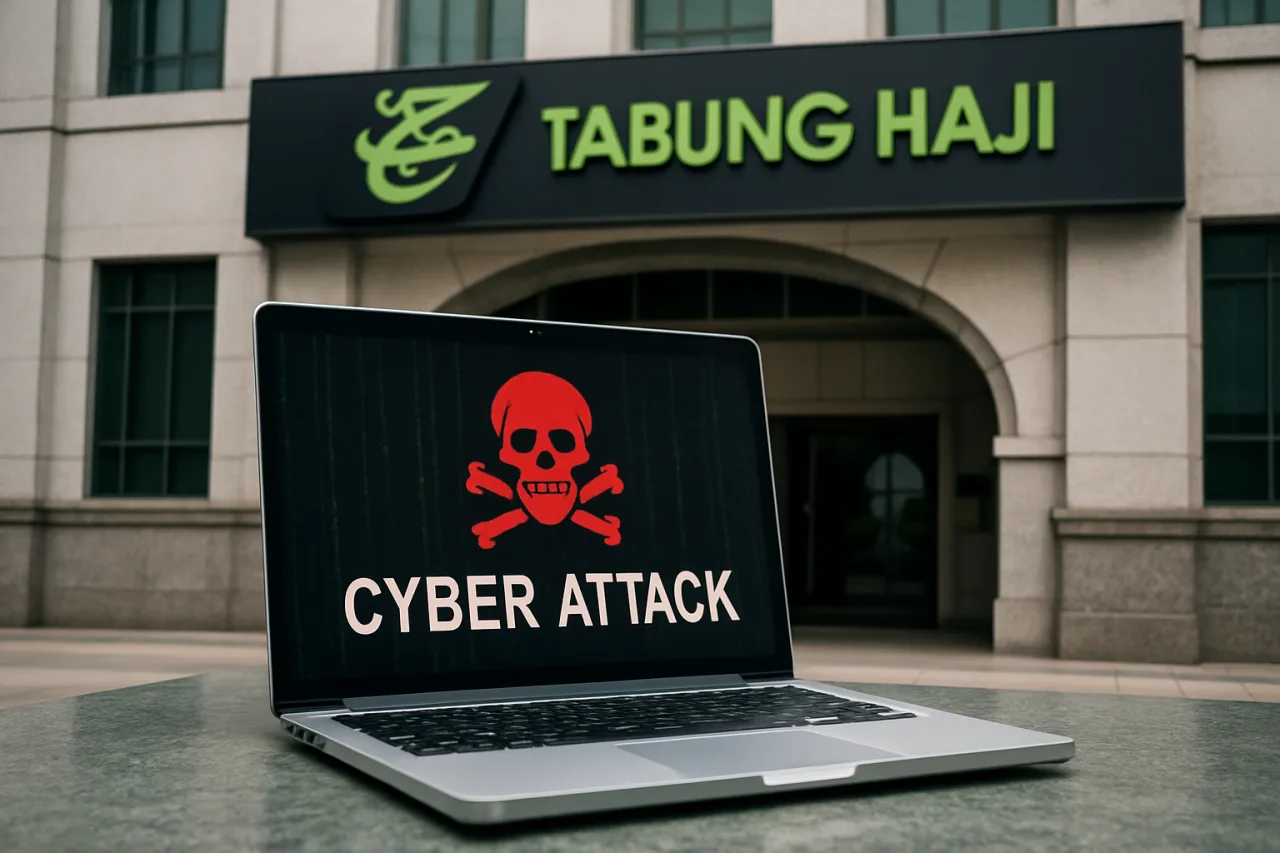
Tabung Haji, Malaysia’s national pilgrimage fund, is back to near-full operations after a Tabung Haji cyberattack scare that shut every customer channel for four days — and the useful part of the story is not the apology, it is the playbook. Per FMT’s October 12 report, TH detected suspicious cyber activity on October 7, suspended all services from October 8 as a precaution, filed reports with the police, the National Cyber Security Agency (NACSA), and the personal data protection department, then brought core systems back after comprehensive security checks, strengthened controls, and system recovery measures.
The statement calls the incident a criminal act aimed at disrupting operations — and it makes zero claims about attack type, actor, or data theft.
That restraint is the signal worth copying. Malaysia is not a quiet place for this kind of event: ransomware.live-based reporting gathered in August 2026 logged more than 30 ransomware incidents in the country in the first half of 2026 alone, and IntelFusions’ October 4 tracking counted 8 leak-site claims against Southeast Asian organisations in a single week, inside a 5–17 claims-per-week regional baseline since July. A national fund going dark for four days and coming back with everything confirmed — that is not a freak event; it is the region’s best documented full-cycle example this year that suspend-first works.
Mediacorp Berita’s separate Malay-language report (October 12) adds the deposit-facing details: depositors who spot unusual activity are told to contact THCC at 03-6207 1919, and updates flow through TH’s official channels. That hotline, and the verification habit around it, is the point this piece is built on — because the next financial-institution outage is a when, not an if, and the response checklist is the part that transfers.
What Happened: The Tabung Haji Cyberattack Timeline
The Tabung Haji cyberattack signal arrived on October 7, when TH detected suspicious activity on its systems. What the detection method was — an internal alert, a partner report, an external notification — is unknown at this stage, because TH’s statement does not specify it and no agency has filled the gap.
On October 8, TH suspended services across all channels as a precaution. That means the whole surface at once: THiJARI web and mobile, branch counters, and whatever ran through partner rails — not one degraded component. A precautionary suspension is the cheap move when the alternative is a half-open system that leaks while it serves. The same day, TH filed reports with the police, NACSA (the National Cyber Security Agency), and JPDP, the personal data protection department. That is the three-authority filing chain: criminal record, national cyber coordination, and data-protection clock, opened in one day.
Investigation ran October 8–11 with three layers working together: TH’s internal teams, external cybersecurity experts, and national cyber authorities, tasked to investigate the incident, address the threat, and restore the systems. This is the layering that gives a recovery its credibility — an internal team alone cannot prove no compromise; a regulator’s checklist plus outside specialists plus the national cyber agency can.
Recovery landed in a deliberate sequence rather than a single flip. TH’s branches in Kedah, Terengganu, and Kelantan resumed on October 11; branches in other states reopened as usual on October 12. Services through strategic banking partners were reactivated in the same window.
On the digital side, all THiJARI functions resumed except three: password resets, new user registration, and online account opening. TH’s statement says these three need further recovery measures before reactivation, with updates through official channels. The choice is rational: reset and registration flows are where stolen identities monetize fastest during a recovery window, and leaving them dark keeps the fraud surface small while monitoring continues.
TH closed the loop with the sentence depositors actually need: “TH assures that depositors’ savings are safe. Close monitoring and security enhancements will continue to ensure that the reactivated systems and services operate safely and smoothly” (per The Star’s reading of the statement). TH also apologised to depositors for the service disruption, and labelled the Tabung Haji cyberattack a criminal act against the institution and the country, aimed at disrupting its operations and services.
Why the Tabung Haji Cyberattack Response Deserves Study
Suspend-first is not the cheapest response, and that is the point. Every hour dark costs a fund with millions of depositors real money and real trust; the decision to go dark anyway is what buys the ability to say, five days later, “savings confirmed safe” as a verified statement instead of a hope. The Tabung Haji cyberattack ran this trade in public: nobody knew for four days whether deposits were touched, and the payoff for waiting is that the confirmation carries weight.
The three-authority filing chain matters for the same reason. A police report opens the criminal record for whatever the investigation concludes. NACSA engages national cyber coordination. JPDP puts personal-data obligations on the clock from day one. If personal data was taken in the Tabung Haji cyberattack, the JPDP filing is already in place; if it was not, the fund has a regulator-auditable record that it moved within 24 hours of detection. Either way, the filing chain is the structure a regulator can read later without asking TH to re-narrate its own week.
The staged re-open is the third leg. Branches returned state-by-state over two days, partner rails reactivated alongside, and only the three highest-fraud-value THiJARI functions stayed dark on purpose. Compare that with a big-bang restore where everything flips at once: a staged return means the monitoring teams watch one re-opening wave while the next waits, rather than watching the whole surface at once.

The last leg of the Tabung Haji cyberattack response is what TH did not say. The statement names no attack type, no threat actor, and no data-theft finding. Unknown labels are the honest reading: the vector is unknown, the actor is unknown, whether any personal data was exfiltrated is unknown. Reports describe the incident as a criminal act aimed at disrupting operations and services — that characterisation is TH’s own, and it is a fact about the statement, not a fact about the attacker. Anyone who tells you which group did it, or that data did or did not leave, is forecasting, not reporting; the leak-site ledger so far shows no crew claiming the incident.
The Tabung Haji Cyberattack in Regional Context
The event is the region’s most instructive full-cycle example this year, and the backdrop explains why: Southeast Asia sits inside a standing leak-site listing floor — 5 to 17 claims against regional organisations per week since July 2026, per IntelFusions — and Malaysia recorded 30-plus ransomware incidents in H1 2026 (ransomware.live-based reporting, August 2026). An airline, a coal producer, a children’s hospital, a hosting provider, a mall, an English-centre chain, and a restaurant chain all appeared on leak sites in one early-October week. Only some end with confirmation: the Malindo Air breach became a confirmed insider case within days of its listing, while most listings stay claims forever.
A pilgrimage fund is a different class of target than any of those, for one reason: the account balance is a life event. Hajj savings accumulate over years against a fixed religious deadline, and the people holding them include retirees and families wiring money from abroad. That is the audience a four-day outage actually lands on — and it is the same audience a ransomware crew listing a national institution thinks about when it picks names: maximum disruption per hour of dark. The Tabung Haji cyberattack gave the region its cleanest demonstration that suspend-first plus a filing chain plus a staged re-open can hold that line.
For readers outside Malaysia, the transferable part is not the fund; it is the response shape: detect, suspend everything, file with police plus the sector regulator plus the data-protection authority, investigate with internal plus external plus national-cyber layers, re-open in stages, confirm the money last. That full-cycle shape is now documented in one public thread that any bank, fund, or cooperative in the region can read and adapt.
What Filipino and OFW Families Should Do Differently
Most Tabung Haji depositors are Malaysian, but the corridor that touches Filipinos is real: hajj savings accounts held by Filipino Muslim workers in Malaysia, remittance-linked accounts where an OFW’s family in Malaysia or a Malaysian worker’s family in the Philippines keeps transfer rails, and the simple habit that any outage demands — verify before you wire. The Tabung Haji cyberattack interrupted exactly those rails for four days, and the practical lessons are:

- Verify before you wire. If a family member’s remittance, tuition transfer, or savings top-up touched the fund between October 8 and 12, confirm it landed before sending the next one. Outage windows are where transfers go missing and double-payments happen.
- Trust the hotline, not a callback. THCC 03-6207 1919 is the contact TH published for unusual-activity reports. A number that calls YOU during an outage, quoting the news, is not the hotline — dial the published one yourself.
- Expect the follow-up scam wave. While THiJARI password resets are down, a criminal who wants accounts has a perfect story: “TH is resetting passwords; confirm yours.” No legitimate reset happens through a call, a WhatsApp message, or a link right now. Treat every outage-news call as a red flag.
The same habits apply to every financial service a OFW family touches — Philippine digital banks, remittance apps, regional providers: the outage-verification discipline is identical everywhere. For credentials across SSS, BIR, DMW, and government portals, the 20-minute password-manager vault build is the standing defense; for the scam-call infrastructure that uses outages as cover, Singapore’s 2026 scam-loss statistics show what regional scam economies do with a good story.
The Outage Playbook: 6 Actions for Depositors and OFW Family Members
- Check statements for unusual activity now. Look at transactions between October 7 and today, on every account touched; anything unrecognised goes to THCC at 03-6207 1919. Depositors with unusual activity are exactly who TH asked to call.
- Use official channels only. For anything about the Tabung Haji cyberattack, TH’s official website, verified social accounts, and the THiJARI in-app notices are the sources of truth. Treat any other number, link, or “TH agent” as unverified.
- Treat outage-news calls as red flags. A caller who knows the news headlines but asks for passwords, OTPs, or “verification” details is working the outage, not servicing it. TH confirms savings are safe via statements and official channels, never through a phone request for credentials.
- Expect the password-reset phishing wave while THiJARI resets are down. With password resets officially unavailable, any “reset your password now” link is bogus by definition — the real channel is dark. When TH re-enables resets, do them only by typing THiJARI’s address yourself, never through a link someone sent.
- Document everything before contacting THCC. Screenshot the statement entries, note dates, amounts, and any failed transfers, then call 03-6207 1919 with the record in hand. Documentation first is what makes the report usable by the fund, the police report, and — if it comes to that — the JPDP process.
- Keep monitoring until the three THiJARI functions return. Password resets, new user registration, and online account opening are still dark; until TH re-enables them via official channels, assume any offer to “help” with those three is a scam setup.
Why This Playbook Outlives the News Cycle
Next quarter, another institution in Southeast Asia will detect suspicious activity and face the same four-way choice: go dark first or keep serving, file fast or file late, re-open in stages or flip everything at once, confirm the money or imply the money. The Tabung Haji cyberattack is the reference case those decisions will cite — the first of 2026, in the region’s most-targeted sector, completed in five days with a regulator-readable record.
The verification habit that outlives the Tabung Haji cyberattack transfers to every reader: check statements against what the institution officially says, use the institution’s published contact points and nothing else, and document before you report. That checklist costs nothing, needs no tools, and works for every outage that follows — bank, fund, wallet, or remittance app.
What to Watch Next in the Tabung Haji Cyberattack Case
- The three THiJARI functions. The recovery endpoint of the Tabung Haji cyberattack is this: watch TH’s official channels for password resets, new user registration, and online account opening coming back; their reactivation is the recovery’s real endpoint.
- JPDP’s read on personal data. If any data-exposure finding lands, it arrives through the JPDP process or an updated TH statement — treat everything before that as unconfirmed.
- Scam-wave follow-through. Post-outage scam calls quoting the news are the predictable second wave; whether Malaysian authorities publicly warn about them is the signal to watch.
- The leak-site ledger. If a ransomware crew ever claims this incident, that claim joins the same verification standard as every other listing: claim-vs-confirmed, nothing more. So far, none has.
Tabung Haji Cyberattack FAQ
Is my money safe in Tabung Haji after the cyberattack?
Per TH’s October 12 statement, depositors’ savings are confirmed safe, core systems and services have resumed, and monitoring continues. The Tabung Haji cyberattack suspension was precautionary, and recovery completed October 12 except for three THiJARI functions.
Which Tabung Haji services are still down?
Three THiJARI functions remain unavailable: password resets, new user registration, and online account opening. Everything else affected by the Tabung Haji cyberattack — branch counters nationwide, strategic banking partner services, and every other THiJARI function — has resumed.
What number do I call about unusual activity in my Tabung Haji account?
THCC at 03-6207 1919, published by TH for unusual-activity reports. Check your statement first, document the entries, then call. Any number that calls you first — even one quoting the news — is not the hotline.
Was personal data stolen in the Tabung Haji cyberattack?
Unknown. TH filed a report with JPDP, the personal data protection department, as part of its response, but no data-theft finding has been confirmed as of October 12. Treat any claim of stolen data as unverified until TH or JPDP says otherwise.
Who attacked Tabung Haji?
No attribution exists. TH describes the incident as a criminal act aimed at disrupting operations; no attack type, actor, or method has been confirmed, and no leak-site crew claimed the incident as of October 12.
Should I change my Tabung Haji password now?
You cannot through THiJARI right now — password resets are one of the three functions still down. When TH re-enables resets via official channels, type THiJARI’s address yourself and never use a link from a message. A “reset now” prompt arriving while resets are officially down is a phishing attempt.
How does this affect Filipinos and OFW families?
Through hajj savings accounts held by Filipino workers in Malaysia, remittance-linked accounts, and the corridor habit: verify before you wire, dial published hotlines yourself, and treat outage-related calls asking for credentials as scams. The response checklist is identical for any financial outage anywhere in the corridor.
Sources and How to Cite This Article
Facts in this piece trace to: Tabung Haji’s October 12, 2026 statement as reported by Free Malaysia Today and The Star; Mediacorp Berita’s October 12, 2026 report (police, NACSA, and JPDP filings; THCC hotline 03-6207 1919; official-channels updates); IntelFusions’ Southeast Asia leak-site tracking (October 4, 2026); and ransomware.live-based H1 2026 Malaysia ransomware reporting (August 2026). Attack type, threat actor, and data-exfiltration status remain unconfirmed by Tabung Haji as of October 12, 2026.
How to cite this page. Cite as: WorldNgayon, “Tabung Haji Cyberattack: The 5-Step Playbook That Protects Your Savings,” WorldNgayon, October 12, 2026, worldngayon.com.
WorldNgayon delivers Digital Intelligence for the AI-powered world: check your statements this week, save the hotline before you need it, and treat every outage-news call as a red flag — the playbook above is the starting line for the next outage, whoever it hits.